P.E.A.R.

P.E.A.R.
Psychology. Education. Advocacy. Research.
Showing posts with label public school. Show all posts

Sunday, February 2, 2014

Homeschooling A Child On The Autism Spectrum

Homeschooling a child on the autism spectrum, is not for the faint-at-heart, nor is it for the strong-at-heart.  The ability to homeschool children on the autism spectrum is for the one that is willing to envision themselves as "a student of another person's mind". In other words, one must be willing to "look inside" and learn the mind of the ones they teach, as they teach. Taking the time to get to know how a student thinks, relates, processes, and perceives the world around them is very important in the beginning stages of homeschooling.  Furthermore, during every lesson one must keep in mind the student on the spectrum may not see, hear, feel, or understand concepts, ideas, and language in the same way they do. 
 
I have been homeschooling our little girl for a total of six years now.  She is on the autism spectrum with a moderate-to-severe delay in language and communication skills. My husband and I placed her in a public school setting for a short while. Then we placed her in a private, homeschool setting for a year while I completed some college degree requirements. The main reasons we chose to homeschool was a desire to see her thrive in our society and because of her problematic behavioral expressions. 


The Power of High Expectations

Our daughter is eight-years old now, and I still find it humorous when someone says to me, "While she was with me, she did not behave inappropriately". I always smile politely and say, "I am very happy to hear that" and I really am. However, when low expectations are all that are required, my little girl will be the most pleasant child you will ever see. Arguably this is the case even for children not on the autism spectrum. High expectations will many times invoke a charged environment. The charge of high expectations may increase problematic behaviors within an academic setting (e.g., avoidance, aversion, anxiety, or frustration). Additionally, if a child also has a learning disability such as dyslexia, then a teacher with high expectations may experience an increase in behaviors that are not conducive for learning. This is why it is very important to know and continuously learn the child's mind.  Specifically, it is important to know the deficits and strengths within the child's mind as they relate to each lesson concept and idea. If one begins homeschooling a child on the spectrum without going through the process of learning their mind, one will experience an increase in the student's problematic behaviors and an increase in irritation within themselves. This irritation will further complicate this already complex process.
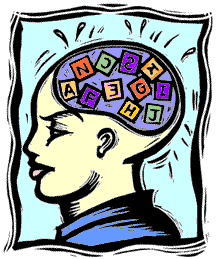
 
When I first began homeschooling, I clearly understood (and research had thoroughly revealed) the numerous symptoms associated with autism spectrum disorder (ASD) may be very stressful for parent's during day-to-day tasks, especially aggressive behavioral expressions. There were times when I did not believe I would be able to effectively teach my little girl.  This is because I did not know how to teach someone that exhibited low concentration and high distractibility.  I did not know how to draw her attention away from her world. Moreover, I did not know how to teach her how to communicate her needs to me in a way that did not include high-pitched, screaming tantrums. I had numerous behavior therapists continuously share with me wonderful ideas and programs that could potentially decrease inappropriate behaviors.  However, at that time it was not possible for me to realistically set-up these behavioral programs, while at the same time playing the role of her physical therapist, speech therapist, physical education teacher, music teacher, academic teacher, and mother.  I began to feel I was fighting a losing battle, because her aggressive behaviors, poor concentration, and high distractibility began to wear me out.
 
 
Always Keep This In Mind
 
So what did I do?  I decided to take the time to build up her school lessons in a way that gradually required more and more of her attention and concentration (much like a behavior therapist would do, accept in ways that flowed into our normal, day-to-day routines). For every lesson objective, I consciously factored in the possibility of slow processing issues, receptive language & expressive communication delays, working memory deficits, and mild dyslexia. Many children on the spectrum are known to have great abilities in some academic areas while there are large gaps in other areas. Using short cuts, skipping basic fundamental skills, and using worksheets to introduce concepts and ideas may cause confusion in the long-term. It is very important to start with the most fundamental component of your lesson objective and slowly build on that. This foundation will prove to be very beneficial if or when your child experiences regression, as mine does.

Many children on the spectrum are concrete thinkers (opposite of myself) and need visual, hands-on activities when learning, especially when first learning a concept or idea. Furthermore, hand-over-hand demonstrations and modeling are two of the most effective ways to teach.  For example, my daughter is currently learning how to write on advanced writing paper. Whenever I introduce new sentences, I place my hand on top of her hand and guide her writing.  Actually, if I see she is having difficulty with anything, this is always my go-to method. Another example is when we are learning new words, I sound out each word as I write it, (super slow, as if I am learning it myself), repeatedly. It is amazing how much she learns and retains from these two simple instructional methods. One more example is in math. It really helps her complete math problems when we take turns doing the math problems. It is like a game. "You do one, then I do one". This method allows me to see where she is having difficulties and it helps to keep her focused on completing the problems. After a few times of this, I then say, "Ok, now you do two and I do one". I am continuously thinking up new methods on how to break down and build up concepts and subjects in ways my daughter understands. 
 
 
To Homeschool or Not To Homeschool?

The decision to homeschool is one that requires a lot of thought.  I was not a very organized or structured person at the start of this. It has taken a lot of effort, late nights, and mental focus to be where we are now.

Patience is something else I did not possess at the beginning of this process. Without the acquisition of patience, I would not be qualified to teach my daughter because she sometimes requires a long duration of time to respond correctly to a task. Moreover, I found out that breaking down lesson objectives, repetition of specific lesson components, and her working memory deficits required a lot of pure and quiet patience. Patience is actually one of the key attributes to have when homeschooling individuals on the spectrum.  I believe the acquisition of this attribute is the main reason we work so well together.  It took me a while to get there, but I understand her so much more now.

Learning how to decrease problematic behaviors effectively is another key component in homeschooling successfully. Without learning how to effectively do this, instructional methods such as hand-over-hand and modeling are very difficult to carry out. I use many different ways to bring my daughter's mind and behavior into learning mode. In subsequent posts, I will share some of the most effective approaches I have used to increase her attention and concentration and decrease her aggressive behaviors.

I have had many people tell me they do not understand how I am doing it. I tell them all the same thing, "I am doing it because I can now". At the start of this progressive process, I had absolutely no idea what I was doing, and currently I still fail and learn something new every week. Failures and successes are absolute constants in the progressive process of homeschooling.  Take your time!


Wednesday, August 15, 2012

Most Important When Teaching a Child With Autism...

The number one thing you will need to teach your child or someone else's child that has been diagnosed with an autism spectrum disorder (ASD) is a willingness to learn how he or she learns.  I set forth on this adventurous journey four years ago and believe me when I say I did not have "the willingness to learn how" my non-verbal daughter learned.  I did not have a clue where to begin or how her mind operated.  Furthermore, I would soon figure out that the way I learned many things up to that point, would more than likely be quite different than the way she would learn the same things.

These realities along with my daughter's monumental melt-downs, deficits in receptive understanding, learning disabilities, and short-attention-span made me wonder (more than twice) if I would be able to handle all the challenges that were promised to present themselves.  In the process of figuring that out, I realized I would have to go places in my own mind that I never knew existed. To me, it seemed as if I was being required to walk down long tunnels and zig-zag pathways in order to understand how my daughter perceived the world.  During the process of "learning how she learns", I learned a lot about myself.


The Backwards E Turned Forward
I have always pondered how we learn, what we learn, and why we learn the things we learn.  We are raised in a world, a society, and in a family that "passes" down useful methods on how to learn, live, and survive.  However, what I found out was that many of those methods flew out of the window when it came time to teach my little girl phonics, math concepts, telling time, counting money, "how old are you", about the sky, sun, and the planets, and why lowercase a's and t's sometimes look different.  I couldn't understand why she continuously forgot what I believed to be the simplest of concepts, such as "more or less".  Why did she write her upper case E's, S's, 2's, D's, and B's backward?  Why did it seem as if she couldn't understand the easiest questions like "Show me Nemo's dad?", even after we had seen Finding Nemo too many times.
Marlin from Finding Nemo

After one solid month of homeschooling, frustration quickly set in.  It got so bad that I couldn't think things through.  I couldn't focus on what lesson to move onto or which lesson to stay with.  My creativity began to wane and I began to wonder, "Am I capable of homeschooling my little girl?"  I started to believe I wasn't.  But one day I stopped everything and watched her play.  I had done this thousands of times, but this time was different.  I began to understand I did not have any idea how the inner workings of my daughter's mind operated.  I made a decision to find out how her mind operates.   This one decision changed our entire homeschooling experience.  

No, it did not get any easier.  I just realized that my own mind had to slow down in order to understand hers (I will add that it seemed like her mind was going a hundred miles per hour, at times).  I decided to stop making her "come out" of her world and I took the time to "go into" her world with her and play games or make-believe.  

Our Home School


Many children diagnosed with an ASD love water, bright lights, and sensory-stimulating games and activities.  I watched my little girl and learned what made her happy and what she liked to do while she was in her world.  I then made the step forward to enter her world.  After a while, my daughter began to see I was genuinely interested in what was going on in her world.  She then became more and more interested in the tasks that I requested her to complete.  This was especially apparent when I brought activities from her world out and used them in our lessons.  In education, this is a form of "motivating through restricted interests".  I found that many times her interests were restricted because she had problems understanding what was going on around her, so she chose to focus on something she could understand.  


The visual mind of many children diagnosed with an ASD is vivid, bright, and full of sensory-like animations.  Pictures, videos (YouTube), and my own created performances and lessons (real-life & video) are how I was able to teach my daughter about our solar system, the human body, and various other concepts.  Technology also proved to be a great help.  My little girl's father (my husband) created wonderfully, animated PowerPoint presentations that explained the concepts of addition and subtraction.  Worksheets were built using online software, Microsoft Word, and educational websites.  There are many online educational resources that are very user-friendly.  We currently use IXL.com for math and Starfall.com for reading. 

Some of the methods and strategies I used while homeschooling were:

Discrete Trial Teaching (Training) - This website provides you with the all the information you will need to implement this teaching approach.  You will find step-by-step instructions as well as an implementation checklist.

Time Delay Instruction - Here you will find step-by-step instructions, an implementation checklist, and data collection sheets.

Restricted Interests as Motivators - This is a wonderful journal article on how effective this instructional approach can be.  Pixar Animations worked well for my daughter.  She learned to write by writing stories directly from the "beginning reader" books.  She also learned to count, picture name, and read from all of these books.  As she grew older, I used whatever she was interested in to move her from one concept to the next.  Buzz Lightyear did wonders in explaining the "space" concept to her. 
Pixar Animations Worked Wonders! 

Visually appealing instructional environment - word walls, wall areas that are papered up for drawing, painting, and/or writing, age-appropriate songs & poems hanging up, animals, picture concepts, colors, shapes, etc.  

Repetition - The practice of taking a task and repeating it over and over and over.  Sometimes it may take as many as one hundred times before the concept comes to life.  I will admit this "technique" just about drove me mad until right after I realized my little girl was pronouncing words better, her vocabulary began to steadily increase, her writing became more legible, and she began to understand that certain behavior was inappropriate.  The practice of repetition can be very monotonous but once you see the first hurdle the child jumps because of it, it will become apart of how you teach.

"The world" as one big learning environment -  There are great and wonderful things to be learned at the park, at the zoo, at the pool, and everywhere else around the Earth.  The first time my daughter learned how to write her numbers was in the sand at a playground.  FUN!


Four years ago, if someone had told me that my daughter would one day be reading, writing, and doing math, I would never in a million years have believed it would have been because I taught her   We still have a long way to go, but I am very thankful that I was given the opportunity to teach my child for as long as I did.  And more than anything, I am thankful I got to see my daughter's face light up every time she learned something new.  

If you have any concerns or questions or would like to share your experiences, find me on the youAUT2know Facebook page.  Or you could simply leave a comment here.

Tuesday, May 8, 2012

Video cameras "speak" for children with disabilities!

Our little girl was diagnosed with autism spectrum disorder when she was 3-years old.  From the time of her diagnosis to the present, I have turned down paid employment to homeschool her.  In November 2011, I began writing my dissertation, so we decided to place her in a public school setting.  As many parents have stated, I also thought things were going well and there was nothing to be concerned about.  Even with that being the case, I still chose to begin a petition asking the Texas State legislature to introduce legislation that would require the installation of video cameras in all public school special education classrooms.  Why?  One word: Insanity.

In all honesty, I try to keep sanity as the supreme mental faculty in my mind by staying far away from the horrible expressions of mankind.  Expressions of torture, violence, beating, verbal abuse, involuntary restraint, and the like.  However, recently I felt a tug on my heart to "step a little harder into the throes of reality".  I decided to read the many comments responding to varying news articles on the fervent and merciless abuse of children with special needs.  The comments ran along a very depressing spectrum filled with pain, anger, and distrust in a system that is suppose to serve, teach, and protect our children.  As I read through the comments patterns of helplessness prevailed.  Parents and caregivers feel there is nothing they can do to stop abuse.  Many parents and caregivers feel cheated and outright disrespected because many of the individuals that abused their children are still in the same system (but strategically placed at another school).  Parents and caregivers are battling with mounting anxieties directly related to being "in the dark" about what is going on in their child's classroom.  Things must change! Petition: Give Autistic Children A "Voice".

Sadly, it is not a new revelation that individuals with mental health and developmental disorders are being abused.  Actually, the deeply carved patterns within the annals of history boldly state, "Abuse will occur among this population!"  Thankfully, social change directives like the Individuals with Disabilities Education Act (IDEA) and the Americans with Disabilities Act (ADA of 1990) have put forward laws and guidelines relating to abuse and mishandling individuals with special needs.  (I would like to stop here and personally thank Senator Tom Harkin the author of the IDEA and the ADA of 1990.  He is also the author of the newly introduced  Keep All Students Safe Act.)

Yesterday, May 7, 2012, a special education attorney informed me that there are no laws against putting cameras in special education classrooms.  Actually, in the state of Texas, this decision is up to the school districts.  So why must parents continue to battle through mounting anxieties related to not knowing what is going on in the classrooms of their special needs children?  The reigning response has been confidentiality and privacy issues.  I was a little confused the first time I heard this response because I know in most public schools there are closed-circuit camera systems.  Not only that, but there are also cameras on most public school buses.  So why is it such an issue to install one more video camera in a special education classroom?

Cameras in special education classrooms allow parents and professionals to observe children's behaviors.  Cameras in special education classrooms protect the teachers and the children.  Cameras in special education classrooms give a "voice" to children that are not able to verbally express themselves.  One extra camera will give documented proof of daily activities which will decrease the chance of future allegations.  Sounds like a win-win to me!

Join us in the fight to have cameras installed in ALL special education classrooms by signing this petition.  United we will stand.  Petition: Give Autistic Children A "Voice"! 

Find youAUT2know on Facebook.